Tuesday, June 19, 2018

Welcome to the Free Market of Outrage! The Koch brothers are killing public transit, Trump's putting young children in cages, Monsanto's fighting farmers, 17 years of war and the VA still fails veterans


MEMPHIS, Tenn. - I live part time in downtown Memphis, Tennessee, and I can’t tell you how elated I was when the city’s trolleys recently began running again after a four-year absence. The clang-clang of those vintage electric cars is part of the charm of this old city, and I’d been missing that sound ever since a fire on two of them in 2014 took them all offline for extended repairs and some replacements.

They might never have come back if the federal government hadn’t kicked in $2.6 million to help one of the nation’s poorest cities get at least one of its three trolley lines back in action. Only the Main Street line runs today, but the two others are expected in the not-so-distant future.

How did the Koch Brothers allow that $2.6 million federal outlay get past them? Did you know that the right-wing billionaires and their minions in Congress, state Legislatures and governors’ mansions have been working hard to kill public transit projects across the land?

Their most recent success was in killing a $5.4 billion mass transit plan in Nashville, Tenn., that would have added needed public transportation to one of the South’s—and nation’s—most vibrant, growing cities. Koch drones spread across the city making thousands of phone calls, knocking on doors, spreading the Koch gospel about the evils of taxes and government of any kind that doesn’t support billionaires like themselves.

Oh, and by the way, the Koch industrial conglomerate “is a major producer of gasoline and asphalt, and also makes seatbelts, tires and other automotive parts,” reports New York Times writer Hiroko Tabuchi in an article published today (June 19).  However, “it supports spending tax money on highways and roads.”

The Koch brothers want you to get in that car and drive, burn their gasoline and the rubber off their tires, and please use your seatbelt!

It’s just one of many outrages in what seems to be a daily onslaught these days.

Of course, the latest is the Trump policy toward immigrant families crossing the border to the south, separating thousands of young children from their parents as the government cages them all, then only giving the parents an 800 telephone number when they’re released and trying to find their children again. Attorney General Jeff Sessions cites the Bible in his defense of this Nazi-like program, but who’s surprised by that?

Many of Trump’s legions will never be shamed into backing away from their führer, but sooner or later those who’ve not drunk too deeply of the Kool-Aid will feel the pain themselves that Trump’s government is inflicting on others. They’ll see his own untrustworthiness—remember how he actually seemed to be endorsing sweeping immigration reform just last January then did as much as anyone to scuttle any realistic reform?

We live in a corporate world, and what business wants, business gets. When Arkansas last year sought to ban the weed-killing-but-also-crop-damaging herbicide dicamba, Monsanto intervened like gangbusters, decrying this limitation on free enterprise.  Halliburton and other companies in the military industrial complex have successfully kept this nation at war since 2001, yet three Veterans Administration secretaries in the last four years have failed to make VA hospitals and clinics fulfill minimal promises to suffering veterans.

Here in the South, now the model for the rest of the nation--and that’s not a good thing, folks--politicians won’t fund basic services and fight Medicaid and other programs for the poor tooth and nail, yet they continue to shell out big bucks to corporations. Witness Alabama’s recent willingness to shell out $700 million in incentives to Toyota and Mazda to land a factory.

I could go on, but I don’t have all day. People are protesting, however. Just this week in front of the Governor’s Mansion in Jackson, Mississippi, members of the Poor People’s Campaign burned the Confederate and Mississippi state flags (which carries the Confederate emblem) to protest the racism that has become inherent in modern-day capitalism. It’s a brown as well as a black issue, but, you know, really at bottom it’s a green issue. 

Saturday, June 16, 2018

Special needs workers at Didlake in northern Virginia demand union rights; and riding the City of New Orleans to the Big Easy, where Dylan says "you can almost hear the heavy breathing" of ghosts


Didlake workers say their rights include the right to join a union even if they have disabiities

The Rev. William Barber II and his Poor People’s Campaign have joined striking workers at the nonprofit firm Didlake in Arlington, Va., in their public protest to bring attention to the company’s resistance in recognizing their vote to join a union. Hundreds of workers with special needs work at the Manassas, Va.-based company.

(The Rev. William Barber II)

“We ain’t going to let no corporation turn us around,” sang Barber as he led workers in song and chant recently. “Everybody has a right to live. Forward together, not one step back!

Barber said that “it says in James that when we exploit workers we exploit God.”

The company is “taking advantage of us,” one worker told veteran labor organizer and video filmmaker Richard Bensinger.

Custodial employees at the Army National Guard Readiness Center in Arlington voted 12-6 in favor of unionizing in April 2017. They went on strike May 25. Didlake says past National Labor Relations Board rulings show standard labor practices could be harmful to workers with disabilities like those at Didlake. Unionization might threaten the provision of needed services, the company says. Yet the NLRB regional director has also backed the rights of those workers to unionize.

Didlake works with the federal government on programs requiring counseling and training services to special needs workers. An appeals process with the board is underway on the union issue.

A ride down memory lane to the Big Easy on the City of New Orleans

NEW ORLEANS – I made my first pilgrimage here back in the late 1960s, with my buddies crammed in a jalopy all the way from North Carolina. We stayed at the decrepit Hotel Paris, drank cheap beer on Canal, then wandered down Bourbon, where old-school jazz masters like Papa French and Sweet Emma still performed.

(To the right, yours truly on the City of New Orleans)

My wife Suzanne and I rode in style this time, the City of New Orleans that Arlo Guthrie sang about, enjoying the club car as we passed through the Mississippi Delta with its endless fields, primeval swamps and bayous, tiny, sunburnt towns. In the city, we stayed with our daughter Jessica in the Irish Channel, a short Uber ride to Galatoire’s for a meal I couldn’t have afforded in the 1960s.

Papa French and Sweet Emma are gone, but Steamboat Willie is there on Bourbon, playing Do You Know What It Means to Miss New Orleans? at the Café Beignet. Steamboat knows what it means. Hurricane Katrina forced him to leave, but the former preacher and Bible salesman came back. “I’m doing what I’m supposed to be doing,” he told once during an earlier visit. “I am in the right place.”

(With Steamboat Willie, daughter Jessica Byrd and wife Suzanne at the Cafe Beignet on Bourbon Street)

A different kind of musician, Bob Dylan, says New Orleans is a city where the ghosts of the dead and the laughter of the living are never far apart. “The ghosts race towards the light, you can almost hear the heavy breathing,” he writes in his autobiographical Chronicles. “Around any corner there’s a promise of something daring … something obscenely joyful behind every door—either that or somebody crying with their heads in their hands.”

The great New Orleans photographer Clarence John Laughlin captures this dichotomy in his haunting depictions of tombstones and Greek statues, Corinthian columns, strange figures peeking out of rooftop gables, young women staring off into the distance as if searching for something lost, forgotten or never found. From its founding, New Orleans has offered a “special kind of fantasy,” Laughlin once wrote, whether it’s “the unparalleled development of funereal art in the old burial grounds” or “the wild fantasy of the Mardi Gras.”

One evening we sat in a courtyard with some of Jessica’s neighbors, surrounded by banana plants, giant elephant ears, and cats everywhere. We met an author of children’s books in training to become a voodoo priestess, a writer for the National Enquirer, a former missionary who now operates a women’s clothing store on Magazine Street, a restorer of 100-year-old shotgun houses, a civil engineer with deep roots in New Orleans who has come back home after years of being away.

They talked of their city with joy and pride, of its resilience after the devastation of Katrina in 2005. Dylan wrote Chronicles just before Katrina, but he saw and felt the same. “There are a lot of places I like, but I like New Orleans better,” he wrote. “Everything in New Orleans is a good idea.”

As our train made its way back through the Delta toward Memphis, I studied the passing landscape--an abandoned store with a huge sign offering the promise of “CANDY” inside, junked cars, old graneries and cotton gins, a lone man standing next to his motorcycle on an empty street. I thought of other exotic train rides the world offers—the Orient Express, the Trans-Siberian Railway, the night train I once took from central Poland to Bratislava, Slovakia.

A woman in the group next to us in the club car began singing. She sang about loneliness, how there’s only her husband and her mother in her house, no children. Her friends listened with admiration and asked her how she came up with such music. “I just write ‘em down,” she told them.

Like the city we just left, I told myself, this is a train ride that holds its own with any in the world.

A shorter version of this column on New Orleans appears this week in the Jackson Free Press in Jackson, Mississippi.

-->

Wednesday, May 30, 2018

The Rev. William Barber II leading MLK's flock on a renewed Poor People's Campaign to see through the corporate-political fog that prevents true economic justice


(The Rev. William Barber II in Selma in May 2015. Photo by Joe Atkins)

I met the Rev. William Barber II in Selma, Alabama, back in 2015. He’d come there from his home in North Carolina to commemorate the 50th anniversary of the bloody march by civil rights advocates across Edmund Pettus Bridge.

“We’re here to honor the memory of the sacrifice,” Barber told me. “The very things they marched about have been gutted.”

Barber, president of the North Carolina NAACP, leader of the Moral Monday demonstrations that began there five years ago, is now leading the national Poor People’s Campaign to bring attention to the unfulfilled goals of Martin Luther King Jr.’s original Poor People’s Campaign in 1968, the year King was murdered.

Launched with a mule-cart procession in tiny Marks, Mississippi, King’s campaign was totally in sync with his efforts to help the striking sanitation workers in Memphis that year because the campaign’s goals were economic: a basic income that’s guaranteed, capital availability for minority and small businesses; and full employment.

“The duty of the living is not simply to recall the martyrs of the movement but to continue their work,” New Yorker magazine quoted Barber saying in a recent profile by writer Jelani Cobb.

Indeed, even many Trump supporters, Wall Street Republicans, and Tea Partyers pay homage to past civil rights gains, and the pages of their media organs offer praise for King on his government-designated day each year. As for the economic justice he sought in his last years, however, the silence is deafening.

In addition to his many other roles, Barber, 54, is also pastor of Greenleaf Christian Church in Goldsboro, North Carolina, one of the poorest cities in that state and not far from where this Labor South correspondent grew up.  Goldsboro is the fifth poorest city in the United States with 25 percent of its population mired in poverty, with estimates ranging from 40 to 65 percent of its children poor.

The powers that be on Wall Street, in Washington, D.C., and in state capitals across the land talk a lot about diversity, jobs, freedom. Talk. Big corporations like Nissan compromise organizations like the national office of Barber’s own NAACP with big handouts to keep them from the nitty gritty issues of fairness and equity at the workplace.

Barber, arguably the most dynamic civil rights leader in America today, sees through all that, however, and he’s committed to making others see through it, too.

Friday, May 11, 2018

Latino journalist Manuel Duran sits in a Louisiana immigrant prison for trying to report the truth in a Trumpian world


OXFORD, Miss. – Manuel Duran is a Memphis journalist who covers the Latino community for Memphis Noticias, a Spanish-language news outlet he owns. He’s also a native of El Salvador, and that fact is a reason he’s in prison in Jena, Louisiana, one of the nation’s worst immigrant detention facilities.

My late friend Marty Fishgold, a longtime labor writer in New York City, liked to say that good “journalism is a subversive activity” because it tells truth to power. Veteran Boston journalist Tom Oliphant had this to say about it: “Good reporters are anarchists” because they question all ideologies and authority.

Those are good things, and that’s why journalism gets special protection in the First Amendment to the U.S. Constitution. It may be the best-known promise in that document and why the constitutions of nations as far flung as Poland, Brazil, Egypt and Bangladesh include such language as well.

One could argue that many of those countries don’t practice what they preach. Well, guess what, we don’t either.

The 42-year-old Duran came to Memphis after working as a reporter in his native El Salvador, a war-and-drug-torn country whose cruelest goons trained at the School of the Americas in Fort Benning, Georgia. He’s now facing deportation back to that country, perhaps the equivalent of a death sentence.

Let’s consider why Duran sits in prison—Jena is one of the “worst detention centers” in the United States for its treatment of immigrants, according to Father Michael McAndrew, who works with immigrant communities in Greenwood and north Mississippi.

On April 3 in downtown Memphis, police arrested Duran and eight others who were protesting immigration policies. Police said they were blocking a roadway and Duran refused to move as ordered. The protest also took place without a permit, police said.  Two days later, prosecutors dropped charges against Duran. Charges against most of the protesters are still pending.

Duran was far from a free man, however. U.S. Immigration and Customs Enforcement officers immediately arrested him and sent him to Jena. ICE officials said Duran missed a scheduled appearance in an immigration court in Atlanta back in 2007 and thus had since been living in the States without legal status. Attorneys for Duran said he received no notice to appear that day in 2007, and they have asked the Atlanta court to reopen the case.

If Barack Obama were still president, Duran might be free since he has no criminal history other than misdemeanor driving offenses. Under President Trump, however, none of the 11 million immigrants in this country without full legal status is even temporarily safe from deportation.
“The actions pursued by government officials in this case threaten core First Amendment freedoms that are essential to our democracy,” says a federal petition by the Southern Poverty Law Center seeking Duran’s release. Those freedoms are “the right to criticize and expose the actions of government officials, and the rights of members of the press to write and publish about them.”

Duran’s greatest “crime” may be that he has been critical of the Memphis Police Department in his reporting.  For example, back in July 2017, he reported in a Facebook post allegations that immigration enforcement officials and Memphis police had joined in a traffic stop operation despite claims they do not work together. Memphis police asked Duran to take down the post. His coverage also raised questions about police handling of the case of a Latino immigrant whose body was found in a police impound lot 49 days after he was shot during a robbery.

A long tradition exists of Latino journalists suffering because of their commitment to truth. Perhaps the most famous Latino journalist in U.S. media history was Ruben Salazar, a courageous reporter for the Los Angeles Times and later Spanish-language television station KMEX in Los Angeles. After launching with fellow journalist William Restrepo an investigation into police and sheriff’s department brutality and criminality in early 1970, Salazar was killed later that year by a deputy-fired tear gas projectile while covering a Chicano demonstration. Deputies said they were answering reports of looting and being pelted by bottles and rocks when Salazar was killed.

Some questioned whether Salazar was assassinated because of his reportage. He has been called “la voz de La Raza”, the voice of the people, a martyr to good journalism. A U.S. stamp bears his image.

The Duran case evokes more recent memories of what happened in Jackson, Mississippi, to Daniela Vargas, a 22-year-old native of Argentina who had been living in the United States since the age of 7. Despite earlier protection under the Deferred Action for Childhood Arrivals (DACA) policy, her more recent lapsed status resulted in a March 1 arrest and federal deportation proceedings. An SPLC petition helped win her release nine days later, but her fate remains as uncertain as Manuel Duran’s.

A shorter version of this column appeared this week in the Jackson Free Press in Jackson, Mississippi.

Monday, April 16, 2018

Former SNCC leader Bob Zellner and labor organizers Richard Bensinger and Rose Turner talk about "The Future of Labor" at University of Mississippi campus: Grassroots organizing can overcome both fear and "right to work" laws


(From left to right, Richard Bensinger, Rose Turner and Bob Zellner)

Civil Rights Movement SNCC leader and social activist Bob Zellner joined veteran labor organizers Richard Bensinger and Rose Turner last Friday for a panel discussion of “The Future of Labor” at the University of Mississippi’s Overby Center. A central point in their discussion was that grassroots organizing can overcome "right to work" laws as well as anti-labor forces' greatest weapon: fear.

Sponsored by the campus Radical South organization, which seeks through panel discussions and other events in April to provide an alternative view of the South from that of conservative politicians like Mississippi Gov. Phil Bryant, the panel offered a lively discussion on the status of labor today in the South and across the nation.

Bensinger, a top national labor organizer who helped coordinate the United Auto Workers’ recent campaign at the Nissan plant in Canton, Mississippi, and other auto campaigns in the South, said “right to work” laws across the region aren’t a good thing but also shouldn’t “stand in the way” of a successful campaign. Bensinger co-founded the Institute for Employee Choice, establishing organizing principles for both employers and unions to follow during union campaigns. He advises unions on organizing and experimental organizing strategies in the service sector.

Turner, who led the successful and historic catfish workers strike in the Mississippi Delta in 1990 and has continued to work with catfish and nursing home workers in the region ever since, said organizers “have to organize” and get down to the grassroots level with workers. Turner currently serves as organizing director and executive assistant to the president of the United Food and Commercial Workers Local 1529, based in Memphis.

Zellner, who fought side by side with Martin Luther King Jr., Rosa Parks, John Lewis, Stokely Carmichael and other civil rights leaders during what he calls “The Second Emancipation” of the 1960s, said fear was the great weapon anti-civil rights forces used back then and it is the same weapon anti-labor forces use today. Zellner helped organize the Freedom Rides of 1961 and was the first white Southerner to serve as field secretary of the Student Nonviolent Coordinating Committee.  He continues to be active in the Poor People’s Campaign and the Moral Monday movement in North Carolina with the Rev William Barber.

Fear can be defeated at the workplace just like it was in the South back in the 1960s, the panelists agreed.

Labor South’s Joe Atkins moderated the panel discussion, which included topics ranging from the current teacher strikes and student protests against gun violence to how corporate money has compromised groups such as the NAACP in their support of labor campaigns such as the one at the Nissan plant in Canton.

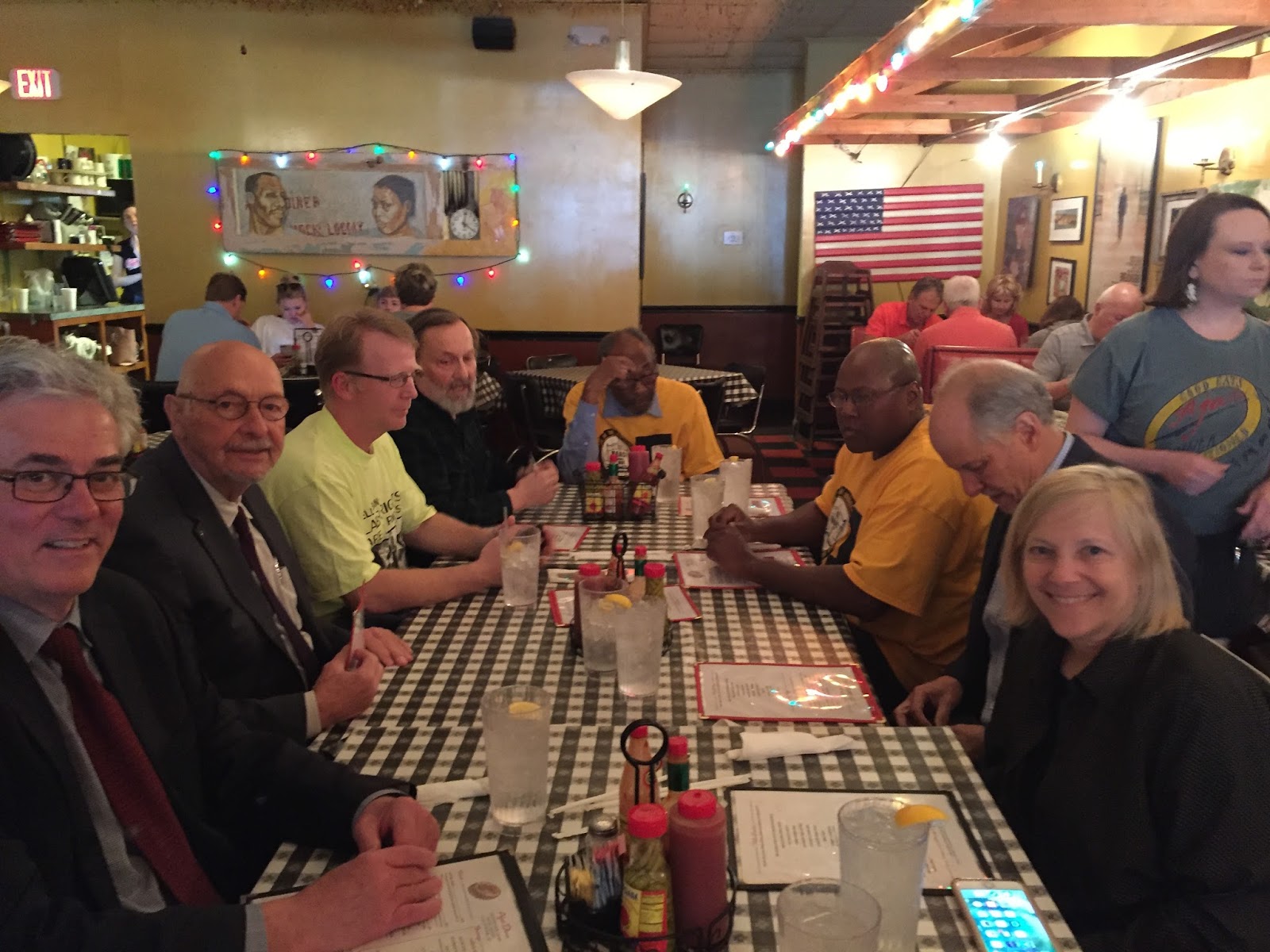
(To the right, at Ajax restaurant in Oxford, from left to right, Joe Atkins, Bob Zellner, pro-UAW workers from the Nissan plant in Canton, Mississippi, Richard Bensinger and his activist wife Virginia Diamond)
 
The panelists’ visit to Oxford, Mississippi, featured dinner and lunch the next day on the city’s famous Square as well as opportunities to sing labor songs such as “I Dreamed I Saw Joe Hill Last Night” and “Union Maids” with fire-breathing, labor organizing, Truman Scholar-winning University of Mississippi student Jaz Brisack. Also joining the group for lunch were several Nissan workers who had campaigned for UAW membership at the Canton plant.

Monday, April 9, 2018

Teachers protesting GOP cutbacks, students protesting gun lawlessness--Long Live the Revolution!


(Dorothy Day in 1934)

OXFORD, Miss. – The great writer and champion of social justice Dorothy Day once said that “fighting for a cause is part of the zest of life.”

She didn’t stop there. “What we need is a revolution. Each one of us can help start it.” A lifelong pacifist, Day wanted a “revolution” that would “build a new society within the shell of the old,” borrowing a slogan from the “Wobblies” in the turn-of-the-century Industrial Workers of the World union.

I remember doing a lot of “fighting for a cause” in my salad days—and later. I shouted, chanted, carried signs, sat in, demanded, wrote letters, and argued and plotted endlessly into the night with my fellow “revolutionaries”—whether the cause was civil rights, Vietnam or worker rights.

That’s why it gladdened my heart when I saw young people across the land—including students of mine like Jaz Brisack--marching and demanding an end to politically sanctioned gun lawlessness in the recent “March for Our Lives” in Washington, D.C., here in Oxford and Jackson, Mississippi, and across the nation.

“We’re not children anymore. We’re warriors,” 16-year-old Oxford High School junior Anna Claire Franklin told the University of Mississippi’s Daily Mississippian. The students are “letting our lawmakers on a state and national level know that the upcoming generations … won’t stand by and allow the ease of buying firearms to be prioritized over the safety of our nation’s students.”

How ironic that the protests took place as Mississippi legislators gave strong support to a bill allowing guns on college campuses. The protests have led to greater gun restrictions in Florida, where the deaths of 17 young people at Majory Stoneman Douglas High School in Parkland February 14 prompted the national outrage against the political bullying of the National Rifle Association.

Also tickling this old revolutionary’s heart are the massive protests by school teachers in West Virginia and Kentucky that have challenged the Koch Brothers and American Legislative Exchange Council-led effort to destroy public education by starving it of funds so that privately run charter schools can take its place.

That nine-day wildcat West Virginia teachers strike forced the state’s billionaire governor and GOP-led legislature to cough up a 5 percent pay hike for all state employees although the politicians planted enough poison in the deal to make sure teachers get blamed for cutbacks in Medicaid and other services.

Kentucky teachers followed suit this month, marching out of their classrooms en masse after state GOP political leaders proposed cutting their benefits. Under pressure, the Republicans dropped their plan although some cuts still loom on the horizon.

Mississippi school teachers are the lowest paid in the nation. A teacher in New York typically makes $37,000 more in annual wages than a teacher in Mississippi. In Mississippi, 13 percent of school teachers have to have second jobs to make ends meet.

Mississippi’s Republican leadership, like their counterparts in Kentucky and West Virginia, get their cues from the Koch Brothers and ALEX on public education just as they do on a host of other issues. They’ll never admit it, but the end of public education is their goal.

So should Mississippi teachers go on strike?

Well, I covered the last major strike by Mississippi school teachers back in 1985. Thousands of teachers across the state marched on Jackson during the 11-week strike, and they finally got the Legislature to agree to a $4,400-over-three-years pay increase. However, it came with a provision that they would never strike again. If they do, they could lose their licenses and their teacher organizations could face fines of up to $20,000 a day.

But, you know, those teachers in West Virginia and Kentucky faced risks, too, just as students protesting against NRA gun lawlessness have already come under attack from right-wing political groups.

When people get fed up enough to go to the streets, they take risks. They know there may “be a price to pay,” Dorothy Day wrote, “sometimes a heartbreaking price. … Neither revolutions nor faith is won without keen suffering.

A shorter version of this column ran recently in the Jackson Free Press in Jackson, Mississippi.

Friday, March 9, 2018

West Virginia teachers challenge the oligarchs and send a message to working people across the country: Stand up for your rights!

 
The victory by West Virginia teachers in their nine-day strike for higher wages and more secure health benefits has already inspired teachers in Oklahoma, Kentucky and other states to consider demanding the same of their legislators.

The wildcat strike was the latest act of public rebellion against the powerful forces that have taken over these United States--Republican legislatures across the land that starve state budgets in order to feed corporate greed, legislators little more than drones for the Koch brothers and the bills-writing ALEC organization, propaganda-spewing Fox “News” and a compliant corporate media that generally ignores worker needs or rights.

Add to that list, of course, the National Rifle Association, which preaches the 2nd Amendment but is really nothing more than the lobbying arm of a weapons industry more concerned with profits than the lives of school children.

The teachers’ strike in West Virginia is indeed viscerally connected to the public reaction to the horrible shooting at the Majory Stoneman Douglas High School in Parkland, Florida. That shooting in February took 17 lives and led to massive protests by students there and across the country against the NRA-spawned madness of our gun laws.

Across the land, people want to know what has happened to this country.

Here’s a hint: comments by West Virginia Senator Lynn Arvon, R-Raleigh, to an aide about the teachers’ strike: “The teachers have to understand that West Virginia is a red state and the free handouts are over.”

Such is the contempt many of our politicians have for regular people like teachers, who’ve gone years without pay raises and who see their pensions and health care plans threatened by legislators who brag about fiscal accountability yet refuse to collect the taxes rightfully owed by corporations, politicians whose own accountability is only to the lobbyists who funnel money into their campaign chests.

Of course, the bipartisan agreement reached by billionaire West Virginia Governor Jim Justice (he is the richest man in West Virginia) and state legislators—with the approval of the American Federation of Teachers-West Virginia and the West Virginia Education Association--to end what was an illegal strike is clearly aimed to make the teachers “look like the bad guy … greedy and selfish,” in the words of one teacher quoted by writer Will Morrow of the World Socialist Website.

The teachers indeed got the 5 percent pay raise they demanded, a pay raise that extended to other government employees such as janitors, secretaries and law enforcement officers. However, they failed to get a tax on energy companies to help fund a health insurance program and got instead a “task force” to look into various options.

To pay for their pay raise, the legislators vowed to cut Medicaid, funding aimed at repairing ailing state buildings, and tuition assistance for students at community and technical colleges. In other words, as West Virginia Senate Finance Committee Chairman Craig Blair said, “there’s going to be some pain.”

And don’t kid yourself. Blair, Justice and the rest of the oligarchy controlling the state fully intend that those suffering from that pain place the blame on school teachers.

What’s encouraging is that the teachers garnered much public support during their strike. West Virginians knew their children’s teachers deserved a pay raise and a securely funded health care plan, and they stood with them despite a mainstream media that here as in most cases either ignores strikes or portrays them through the prism of the inconvenience they cause. So-called “liberal” MSNBC mostly ignored the strike despite its national implications and continued the network’s confounding obsession with finding a Russian excuse for Hillary Clinton’s presidential election loss.

Ironically the strike took place as the U.S. Supreme Court was hearing the so-called “Janus” case aimed at stripping public employee unions of their ability to collect union dues from non-member employees who benefit from their collective bargaining efforts. The ruling could have significant impact on public employee unions across the country.

Back in early 1985, your Labor South reporter covered the historic 11-week public teacher strike in Mississippi. Teachers from across the state marched on the state Capitol in Jackson and finally won a $4,400-over-three-years pay raise agreement. However, in some ways, it was a Pyrrhic victory because the agreement came with a no-strike provision that would fine teacher organizations up to $20,000 a day for future strikes.

As the strike in West Virginia wore on this month, labor historians from far and wide came to the University of Mississippi to participate in a symposium on the 1930s organizing efforts of the United Cannery, Agricultural, Packing and Allied Workers of America union in the South and elsewhere.

The union worked hard to organize both farm and factory workers at the height of the Great Depression but eventually focused on factory workers due to the legal and other difficulties organizing field workers.

“Strikes by field workers who can’t pay dues is costly and a problem,” said Jarod Roll of the University of Mississippi.

Field workers were often the most in need of union protection, yet they weren’t protected by national labor laws (thanks to the Southern Democrats in Congress) and the seasonal, nomadic nature of their work as well as their poverty and pitiably low wages made it difficult to organize them into a union.

(To the right, a Depression-era strike banner from the Southern Tenant Farmers Union on display at the Southern Tenant Farmers Museum in Tyronza, Arkansas)

Still, Roll said, one of the most dynamic labor stories of the 1930s was that of the Southern Tenant Farmers Union, a bi-racial organization founded in the Arkansas Delta which joined UCAPAWA and which won key victories against recalcitrant Southern landowners.

Like the SFTU, the school teachers in West Virginia had the deck stacked against them, but they carried the day even if their victory isn’t across the board. What they did was send a message across the land that people are getting sick and tired of what’s happening in this country. They’re ready to stand up for their rights, and the powers that be better listen.